
Who we are

Associations

Useful information

Monthly newstream newsletter.

Who we are

Useful information

Registration now open.

Become an exhibitor

Already exhibiting?

More opportunities:

Discover StocExpo

Getting here

What's on ?

Pitch lunch

Tank Storage Awards

Exclusive VIP tour

Discover the exhibitor Hub:

Discover an array of products and services…
Stay informed with the latest Exhibitor News….
Delve into a wide array of career prospects…

Discover the Vault

From oil and gas, LNG, tank terminals, biofuels, renewables & the energy transition…..

Watch the highlights of StocExpo 2023 and subscribe to our YouTube channel.

The latest news in the tank storage and energy infrastructure industry.

Showcasing our women in tank community, in collaboration with Tank Storage Magazine.

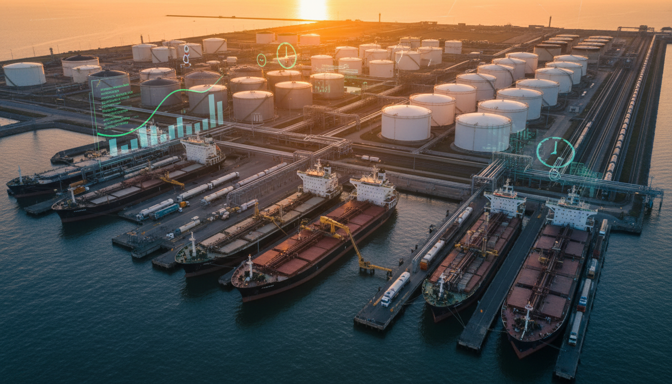
Keeping bulk liquids moving: the terminal’s role in a resilient supply chain

Discover how bulk liquid terminals act as vital hubs, keeping global supply chains flowing smoothly amid rising complexity and disruption. Dive into the innovations and collaborations shaping a resilient future for liquid logistics, including insights from Didier de Beaumont, Commercial Manager at Port of Amsterdam.

In today’s interconnected world, keeping bulk liquids flowing smoothly is no simple task. Terminals stand at the crossroads of production, transport, and distribution, where even minor disruptions ripple through global supply chains. How can terminals adapt to this growing complexity and ensure resilience beyond their gates?

The terminal’s role in the bulk-liquid supply chain

Bulk liquid terminals are key nodes linking production sites, import/export flows, storage, vessels, customers, and distribution networks. They handle liquid and gaseous cargoes like crude oil, refined products, LNG, and chemicals, requiring specialised infrastructure such as tank farms and loading arms. Terminals balance storage and throughput to meet market demands and integrate with pipelines, road, rail, and waterways to ensure seamless product movement. Coordination between terminal operations, shipping schedules, transport providers, and customers is vital for supply chain resilience. As product flows evolve with new fuels and regulations, terminals must adapt infrastructure and services to support safe, reliable, and flexible distribution.

Managing operational interfaces

Terminal efficiency depends on coordinating berth planning, vessel scheduling, loading, and discharge with yard and landside activities. Integration with road, rail, and inland-waterway transport prevents bottlenecks and meets delivery expectations. Effective communication with customers and transport providers enables timely updates and proactive disruption management. Terminal Operating Systems provide real-time visibility and automated scheduling to harmonise these interfaces and enhance resilience.

Building resilience during disruption

Terminals face disruptions from weather, equipment failures, geopolitical tensions, and demand fluctuations. Resilience requires proactive strategies like diversifying supply routes, investing in infrastructure redundancy, and using digital tools for real-time visibility and rapid rerouting. Collaboration across ports, shipping lines, and transport providers ensures coordinated responses. Risk management and scenario planning prepare terminals to adapt swiftly, embedding flexibility and foresight to keep supply chains moving safely despite disruptions.

Data, coordination and practical innovation

Modern terminals rely on seamless data flow and smart coordination. Real-time visibility through sensors and digital twins creates a unified picture, enabling dynamic schedule adjustments to reduce delays. Thoughtful automation streamlines repetitive tasks, freeing teams for strategic decisions. Sharing reliable data across stakeholders fosters collaboration. Balancing sophistication with simplicity avoids overcomplexity, deploying scalable, interoperable tools that enhance decision-making, safety, compliance, and adaptability.

Future fuels and changing cargo flows

Emerging fuels like ammonia, methanol, and biofuels reshape supply chains, requiring new handling protocols and infrastructure upgrades. Close coordination among ports, terminals, and logistics providers is essential. Ammonia adoption depends on harmonised safety standards and bunkering infrastructure, while alcohol fuels leverage existing networks with incremental integration. Ports must balance traditional petroleum with low-carbon alternatives, maintaining safety, quality, and compliance. Collaborative planning aligns investments, operations, and customer needs to support resilient, efficient movement of evolving cargoes in a decarbonising world.

Share this article

banner 548d44fa 16fd 4ffa ad50 274c5a30b073 0 small

Practical questions for supply-chain leaders

Leaders must identify pressure points between terminals and networks, such as berth congestion or transport bottlenecks, where resilience may falter. Understanding which information, shared promptly and accurately, empowers safer, more reliable planning is vital.

  • Is real-time vessel scheduling accessible?
  • Are transport providers informed early to adjust routes?
  • During disruption, how can teams synchronise responses to minimise delays and maintain safety?


 Clear communication protocols and shared visibility across organisations are key. Looking ahead, leaders should consider infrastructure, skills, and systems needed to support shifting product flows and new handling demands. Framing these questions fosters collaboration, anticipates challenges, and drives efficiency and resilience.

Industry perspective

Where can stronger coordination between ports, terminals and supply-chain partners make the greatest difference to the safe and reliable movement of bulk liquids?

“The liquid bulk supply chain in a port area is a complex system involving many different actors. Safety is paramount for every party and therefore sets the boundaries for operational flexibility. The number of organisations involved in handling a single vessel makes seamless coordination challenging. A vessel’s arrival and departure require close interaction between terminals, surveyors, agents, pilots, mooring crews, tugboats and vessel traffic control. Even in today’s highly automated port environment, many of these interactions still rely on manual coordination, often involving numerous phone calls. There is therefore considerable scope for improvement, both in the planning phase and during execution. A more integrated approach, supported by better use of available communication technologies, could improve coordination and enable vessels to move more safely and efficiently through the port area.”

Didier de Beaumont, Commercial Manager, Port of Amsterdam

Imagine a terminal as the heart of a complex organism, pumping bulk liquids through pipelines, vessels, and transport networks. Its resilience depends on coordination, data-driven decisions, and innovation. As supply chains evolve with new fuels and demands, collaboration across ports, terminals, and logistics partners becomes the lifeblood of efficiency and safety. Engage with peers and experts at StocExpo to explore practical solutions and shape the future of bulk liquid supply chains together.

Register your interest

Get social.

#stocexpo #futuredelivered

StocExpo on-demand content

Access the StocExpo on-demand content from 2026.

At Easyfairs, we take your privacy seriously and will only use the information we collect or receive about you in accordance with our privacy policy. If you change your mind you can unsubscribe at any time.